For many players, representing their nation at a World Cup is the pinnacle of their careers, but for various reasons, some of our greatest-ever stars never got the chance to play at the global showpiece.
We’ve pulled together a starting XI and a host of other talented squad members who would surely give the world’s best a run for their money in their prime:
GOALKEEPER: BOB WILSON
Born in Chesterfield and behind the likes of Gordon Banks, Peter Bonetti, Alex Stepney and Peter Shilton in the England pecking order, our legendary shot-stopper took the opportunity to represent Scotland when the rules changed in 1970 to allow players to feature for a parent’s country of birth.
Wilson would win two caps for the Scots in 1971, but wouldn’t feature for them again after that, retiring in 1974, the year that Scotland reached the finals in West Germany. He would though be a regular on our screens at numerous tournaments as a pundit and later presenter for the BBC and ITV.
RIGHT-BACK: LEE DIXON
Only three Gunners played more times than Dixon, who won his first England cap in a 1990 World Cup warm-up match but the experienced duo of Gary Stevens and Paul Parker were eventually selected for Italia 90.
Having amassed 21 caps up to the Three Lions’ failure to qualify for the 1994 World Cup, the emergence of Gary Neville meant Dixon was overlooked by future England bosses, adding just one more cap to his collection by caretaker boss Howard Wilkinson in a friendly against France in 1999.
CENTRE-BACK: FRANK McLINTOCK
Despite being an iconic presence in our backline throughout the 1960s and 1970s, leading us to the Double in 1971, McLintock would only win nine caps for Scotland across an eight-year period, scoring in a famous 6-2 win in Spain in 1963.
However with Dave Mackay, Paddy Crerand, John Greig and Billy Bremner amongst others regularly selected ahead of him, and Scotland’s failure to qualify for the 1966 and 1970 World Cups, the centre-half never had the international career that he deserved.
CENTRE-BACK: STEVE BOULD
Bould forged a watertight central defensive partnership alongside Tony Adams during our title triumphs in 1988/89, 1990/91 and 1997/98, but would only play alongside his clubmate on both of his appearances for England, which came in the space of five days in the summer of 1994 when he was 31.
England’s inability to reach the finals that year meant that Bould never got the chance to feature in that World Cup, despite enjoying a career renaissance under Arsene Wenger as we clinched the 1998 Double.
LEFT-BACK: NIGEL WINTERBURN
The third member of our famous back four included in this line-up played 584 times for us, but just twice for England, as he found opportunities to pull on the Three Lions limited by Stuart Pearce’s presence in the national side.
A first cap came under Sir Bobby Robson in 1989 but Tony Dorigo got the nod to be back-up to Pearce at the 1990 finals in Italy. Graham Taylor handed him a second cap in 1993, but Winterburn would be another victim of England’s failure to reach the 1994 World Cup.
RIGHT MIDFIELD: LIAM BRADY
Unlike many in our side, Brady would actually enjoy a fruitful international career with the Republic of Ireland, winning 72 caps across 16 years, but their star man couldn’t quite get his nation to a World Cup finals, coming close in 1978 and 1982.
Jack Charlton’s appointment saw Brady’s playmaking talents pushed aside in favour of pragmatism. With the team on track to reach the 1990 World Cup, Brady was hooked by Charlton in the first half of a friendly against West Germany, and subsequently retired from international duty.
CENTRAL MIDFIELD: PETER STOREY
A no-nonsense defensive midfielder, Storey was another key member of our side in the 1960s that eventually landed the Double in 1971. He was the only player from that fabled side to be regularly capped by World Cup-winning manager Sir Alf Ramsey, earning his first call-up just before we lifted the First Division title.
That was the first of 15 successive caps for Storey, but he was left on the bench in England’s crucial 1974 World Cup qualifier against Poland which saw them miss out on the finals in West Germany. That brought Ramsey’s legendary tenure to an end, and Storey never played for England again.
CENTRAL MIDFIELD: ALEX JAMES
James was one of our stars of the 1930s, winning four league titles and two FA Cups as a deep-lying creative midfielder. He won his first Scotland cap in 1925 while at Preston North End, but his club’s reluctance to release him for international action was a big reason for his move to north London in 1929.
James famously netted twice in a 5-1 thrashing of England at Wembley in 1928, but the “Wembley Wizards” wouldn’t appear at the first World Cup tournament held in Uruguay two years later. That’s because the home nations weren’t part of FIFA at the time, and also declined an invitation to participate in the inaugural event.
LEFT MIDFIELD: CLIFF BASTIN
One of James’ main targets on the field was Bastin, who would score a bucket load of goals to become our third-highest scorer of all-time during our golden period in the 1930s. His ability to find the back of the net saw him selected for England on 21 occasions, during which he scored 12 times.
However the home nations’ FIFA exile denied him the chance to play at either the 1934 or 1938 tournaments. He did though play in the infamous ‘Battle of Highbury’ when England beat Italy in the Azzurri’s first match after winning the 1934 edition, which was dubbed by the British press as the “real” World Cup final.
STRIKER: CHARLIE GEORGE
There are two remarkable notes about George’s England career – one is that he never appeared for the Three Lions during his time as the King of North London, and the other is that he won just one cap in total, which came at Derby County in 1975.
That appearance saw him shoehorned onto the left wing to accommodate Kevin Keegan up front, and after being subbed, fell out with Don Revie and never played international football again. England’s failure to reach successive World Cups in 1974 and 1978 meant George’s talents would never have been seen on the global stage anyway.
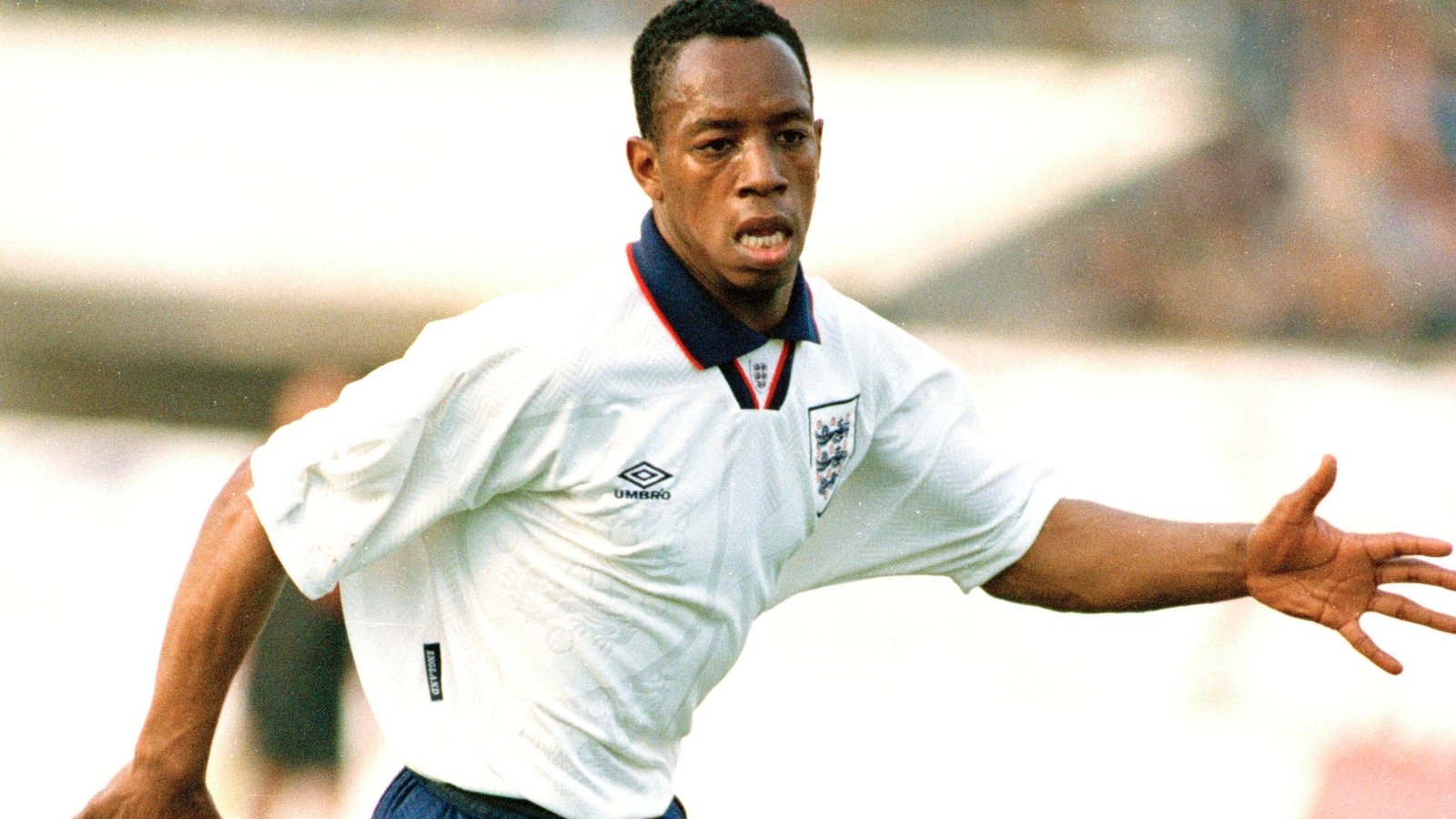
STRIKER: IAN WRIGHT
Our second-highest scorer won 33 caps during an era when English striking talent was abundant. Battling with Gary Lineker, Alan Smith, Alan Shearer, Teddy Sheringham, Robbie Fowler and Michael Owen for gametime, Wrighty never played more than three successive games for the Three Lions.
He scored four goals in the unsuccessful bid to reach the 1994 World Cup, and in 1998 he played another key role in qualification, but picked up an injury on the eve of the tournament and was cut from the provisional squad. Only Mick Channon has played more times for England without being selected for a major tournament.
SUBSTITUTES
A title winner in 1989, John Lukic never played for England and rejected the chance to represent Yugoslavia, who appeared at the 1982 and 1990 World Cups. Ukraine have only made the World Cup once in 2006, either side of the international careers of Oleksandr Zinchenko and Oleg Luzhnyiwho missed the 1990 finals through injury when he represented the Soviet Union.
Pat Rice played for Northern Ireland for 11 years but during an era where they couldn’t reach a World Cup finals, while despite winning virtually every major honour including Euro 2020, Jorginho has never played at a World Cup with Italy’s last appearance coming in 2018 – something Riccardo Calafiori will hope to change in four years’ time.
His current boss Mikel Arteta was on the verge of a first Spain call-up in 2009 before injury struck, and La Roja went on to win the tournament for the first time a year later. George Armstrong was also overlooked for international honours despite strutting his stuff in red and white over 600 times between the 1960s and 1970s.
David Rocastle missed out on Italia 90, having played in five of the six qualifiers but was one of four players cut from the final squad, and either side of his First Division Golden Boots, Alan Smith was also not selected that year when Bobby Robson opted for Steve Bull instead.
Ted Drake scored six times in five England games in the 1930s during their FIFA exile, and David Jack would have also been a shoo-in to play in one of the early editions, as four of his nine caps around this time came as captain. John Radford is our fourth-highest scorer ever but won just two England caps while they were world champions, and was overlooked for the 1970 finals.
In more recent times, Pierre-Emerick Aubameyang has been unable to steer Gabon to their first-ever finals appearance, while his Gunners strike partner Alexandre Lacazette was omitted from the standby list for France’s 2018 winning squad, and hasn’t featured for Les Bleus since.
Copyright 2026 The Arsenal Football Club Limited. Permission to use quotations from this article is granted subject to appropriate credit being given to www.arsenal.com as the source.